
Outlander Filming Locations: The 7 Deadly Pins of Scotland, Chosen by Fans
There is a particular kind of devotion that Outlander inspires in its audience. It is not passive fandom. It is the kind that books flights, plans itineraries, and stands in a Midlothian field trying to locate the exact spot where a fictional wedding took place. Across eight seasons and more than a decade on screen, Diana Gabaldon’s story of time, love and the Scottish Highlands has done something rare: it has turned a television show into a geography lesson, and made millions of people care deeply about where things happened, not just what happened.
The relationship between Outlander and its locations is unusually close. The Scottish landscape is not a backdrop in this series. It is a participant. The moorland, the castles, the closes and the lochs carry weight in the story, and fans feel that weight in a way that continues long after the credits roll. The result is one of the most engaged set-jetting communities in the world, one that has been exploring, photographing and writing about these places since the show first aired in 2014.
We wanted to find out which places matter most. So we asked.
How Fans Built the Map
On Be In The Scene’s Instagram, we put a simple question to the Outlander community: which filming location is your favourite? The response was immediate, multilingual and, in places, genuinely moving.
Fans wrote in from across the world, in English, Spanish, French, Dutch and Portuguese, and what came back was not a list of tourist checkboxes but something closer to a personal map. Places that made them cry. Places they’d visited and could not bring themselves to leave. Places they planned to visit before they died.
From those responses we tallied every named location and ranked them by the weight of feeling behind them. The result is the 7 Deadly Pins: the seven Scottish Outlander filming locations the fandom voted for most passionately.
Every pin here was placed by a fan who felt strongly enough to say so, and the comments behind the numbers are worth reading in their own right.
Sam Heughan, Caitriona Balfe and Be In The Scene
It feels right that this particular map was shaped by its audience, because Outlander has always worked that way. The fandom does not sit on the outside of the story looking in. It inhabits it. And that instinct for location runs right to the heart of the production.
Both Sam Heughan and Caitriona Balfe have created their own personal maps on Be In The Scene, charting the places that shaped their years inside this world. Their presence on the platform is a reminder that the connection between Outlander and its Scottish locations is not simply a matter of production logistics. These are places that matter to the people who made the show as well as the people who watch it.
The seven locations below were chosen by neither of them. They were chosen by you.
The 7 Deadly Pins: Outlander’s Most Loved Scottish Filming Locations
What follows is a guide to each of the seven locations, the scenes filmed there, their place in the fan vote, and the real history and geography that made them worth filming in the first place. They are listed in order of the votes they received. Together they make a map of everything Outlander fans carry with them when they think about Scotland.
Enjoy!

1. Midhope Castle
Midhope Castle serves as the exterior of Lallybroch, the Fraser family estate that functions as the emotional heart of the entire Outlander series. It is where Jamie and Claire first arrived as a married couple, where Jenny held the household together through decades of hardship, and where Claire returns in the 1960s and imagines Jamie walking back through the gate in one of the show’s most quietly devastating moments.
Notably, all interior Lallybroch scenes were shot in a studio. Its dominance in the fan poll is total and it sits in a category entirely its own, drawing responses in multiple languages and prompting some of the most personal and lyrical writing in the entire comment thread. Fans described it as feeling like going home.
The castle itself dates from the 15th century and sits on the vast Hopetoun Estate in West Lothian, about 20 minutes from Edinburgh. It is a genuine ruin, roofless and derelict inside, but the exterior, courtyard, archway and surrounding farmland are accessible to visitors by ticket, and the grounds along Midhope Burn include further filming spots including Jamie’s cave and the scene where Fergus loses his hand.
Abercorn Road, Hopetoun, South Queensferry, EH30 9SL, Scotland

2. Kinloch Rannoch
Kinloch Rannoch and the surrounding Tay Forest Park stand in for the wilderness of North Carolina in the later seasons of Outlander, providing the landscape for Fraser’s Ridge and many of the scenes that defined Jamie and Claire’s life in the New World. The visual match between Perthshire’s forested lochside terrain and the American backcountry is convincing enough that the production returned to the area repeatedly across multiple series.
It placed second in the fan poll, trailing only Midhope, and attracted some of the most vivid descriptions of any location, with fans calling it magical and describing the feeling of standing at the loch’s edge as something that transcends the show entirely.
Kinloch Rannoch is a small village at the eastern end of Loch Rannoch in Perth and Kinross, sitting at the foot of Schiehallion, one of Scotland’s most distinctive mountains. The loch stretches west for roughly 15 kilometres through ancient oak woodland and open moorland, offering some of the most secluded and photogenic landscape in the southern Highlands.
Kinloch Rannoch, Pitlochry, PH16 5PZ, Scotland

3. Bakehouse Close, Edinburgh
Bakehouse Close is the narrow Edinburgh alleyway that stood in for the close-mouth entrance to A. Malcolm’s print shop, the setting for one of Outlander’s most celebrated scenes: the reunion of Jamie and Claire in season three after 20 years apart. Claire descends the close steps, hears the press working, enters the shop and finds Jamie with his back to her, and the audience has been waiting the best part of a season for that moment to arrive.
It placed third in our Instagram poll, with fans singling out the steps specifically and several noting that you can stand there and feel the reunion about to happen.
The close itself is a genuine 17th-century alleyway tucked off the Royal Mile in Edinburgh’s Old Town, just below the Scottish Parliament. It is publicly accessible at all times and largely unchanged from the period the show depicts, which is rather the point of using it.
Bakehouse Close, Edinburgh, EH8 8PE, Scotland

4. Culloden Battlefield
Culloden is woven into the DNA of Outlander from the very first episode, the distant catastrophe that everything in the early seasons is hurtling toward and that reshapes every life in the story that follows. The production filmed at the real battlefield for the season two finale, using the moorland itself to stage the chaos and carnage of the 1746 battle in which the Jacobite cause was extinguished.
It placed fourth in our poll and the emotional register of those responses was noticeably different from the rest: fans described crying on visits, feeling overwhelmed, calling it the most moving stop on the entire trail. This is certainly a moving place to visit with such history.
Culloden Moor sits just east of Inverness and is maintained by the National Trust for Scotland. The battle lasted less than an hour on 16 April 1746 and resulted in roughly 1,500 Jacobite deaths. The site remains largely as it was, the graves of the clan regiments still marked across the open moor, with a visitor centre and guided tours that carry real weight regardless of whether you arrive as an Outlander fan or simply as someone interested in Scottish history.
Culloden Moor, Inverness, IV2 5EU, Scotland

5. Glencoe
Glencoe appears in the opening credits of Outlander’s first season, its dramatic mountains and wide moorland sky providing the visual grammar for the Highland world Claire steps into. The footage established an image of Scotland that lodged in the minds of millions of viewers.
For many people, Glencoe simply is Outlander’s Scotland.
The Glencoe National Nature Reserve, maintained by the National Trust for Scotland, is one of the country’s most significant protected landscapes, a glacial valley of enormous geological and ecological richness. It is also regarded as a monument to one of the most tragic events in Scottish history: the massacre of February 1692, in which government troops quartered in the glen turned on their MacDonald hosts at dawn, killing dozens in an act of betrayal that has never quite been forgotten.
Glencoe, Ballachulish, PH49 4HX, Scotland
6. Culross
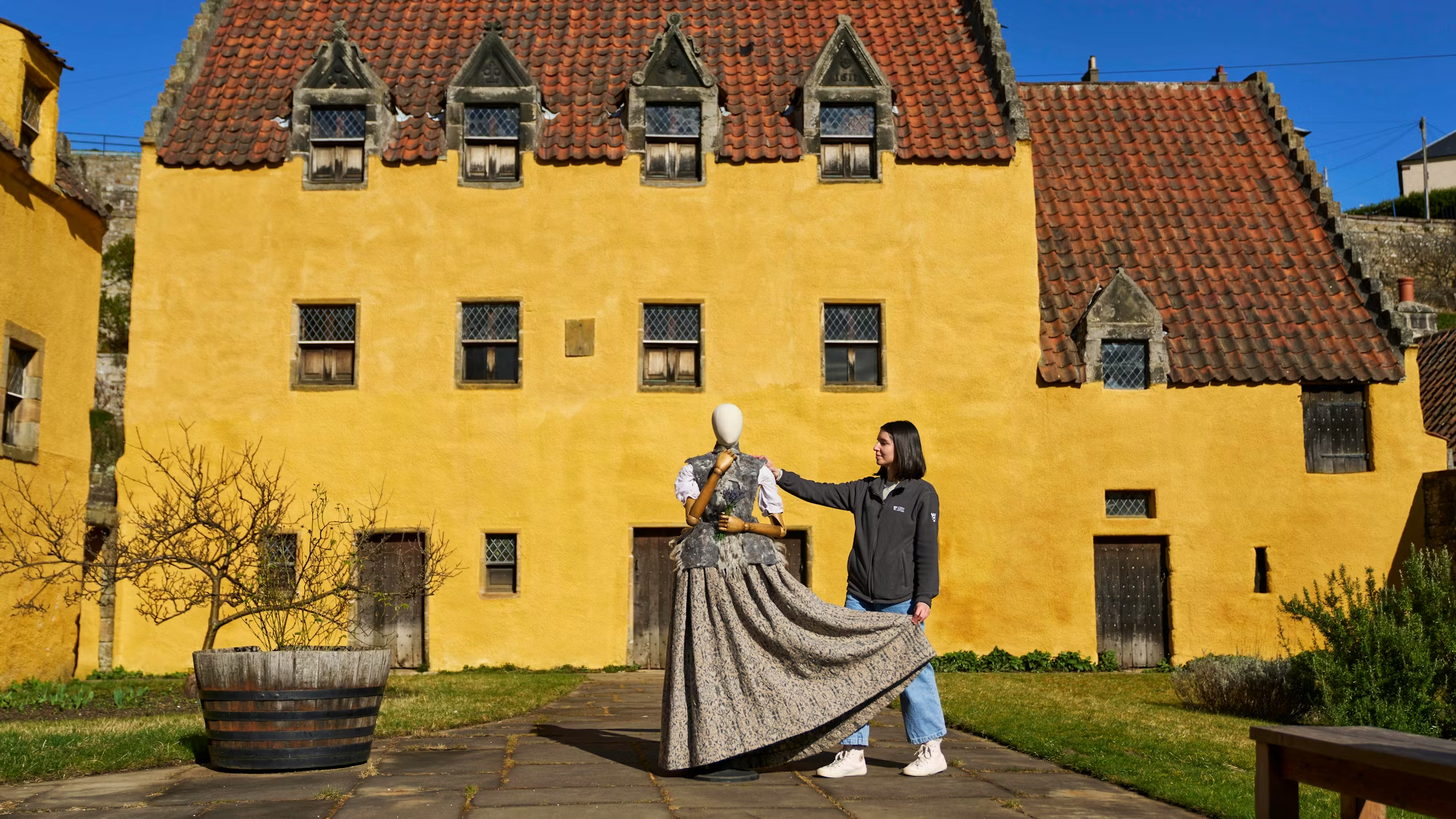
Culross plays the fictional village of Cranesmuir in the early seasons of Outlander, the home of the enigmatic Geillis Duncan and the setting for several of the show’s most atmospheric scenes, including Geillis’s trial for witchcraft and her near-burning at the stake. Its cobbled streets, yellow-painted houses and largely intact 17th-century townscape required almost no dressing from the production, which is a mark of just how extraordinary the village’s preservation is.
It drew many mentions in the poll, with fans tending to name it alongside other Central Belt locations as part of a single-day Edinburgh-based circuit.
Culross is a small royal burgh on the northern shore of the Firth of Forth in Fife, fewer than 400 people live there, and it is one of the best-preserved examples of a Scottish burgh from the 16th and 17th centuries anywhere in the country. The Palace, the Town House and the cobbled Back Causeway are all maintained by the National Trust for Scotland and are open to visitors.
Culross, Dunfermline, KY12 8JH, Scotland

7. Glencorse Old Kirk
Glencorse Old Kirk is the setting for Jamie and Claire’s wedding in season one, the ceremony conducted in haste and under duress that nonetheless anchors the entire emotional architecture of the show. It is a small, restored medieval kirk on the private Glencorse House estate in Midlothian, and the production used its intimate interior and surrounding kirkyard to stage one of the most watched single scenes in the series.
The kirk dates to the 16th century and fell into ruin after the new Glencorse Parish Church was built in the 19th century. The current owners have restored it and use it as a private wedding venue, which means that visitors who want to see it need to contact Glencorse House directly. It sits in the Pentland Hills about 10 miles south of Edinburgh, a quietly beautiful spot that feels appropriately removed from the world.
Milton Bridge, Edinburgh, EH26 0NZ, Scotland
Scotland Through the Lens of Outlander
What strikes you when you read back through the fan responses is not the volume of votes but the register of them. People did not just name places. They described what it felt like to stand in them. The emotion that builds as you walk toward Midhope Castle through the trees. The stillness of Culloden on a winter morning. The way Bakehouse Close makes you feel as though someone has just left the frame.
These are not the responses of people who visited locations because a show told them to. They are the responses of people for whom place and story have become genuinely inseparable. Outlander has done that to Scotland, or perhaps Scotland has done it to Outlander. Either way, the landscape is now part of the narrative in a way that no map of filming locations quite captures on its own.
Our celebratory 7 Deadly Pins: Outlander fan map is a starting point for your own journey through the real places behind the story, built from the collective memory of the people who love it most.
More 7 Deadly Pins: Caitriona Balfe & Sam Heughan


